
As the shadows lengthened at Langlands Park on the afternoon of 23 August, Wayne Stewart scored a try to put Wests ahead of Wynnum Manly by 14 points to 12. While it had been neither pretty or convincing, if the lead held, Wests would finish fourth and play in the Minor Semi-Final against Souths the following weekend.
Across town at Neumann Oval, Valleys were busy dismantling Redcliffe. The Diehards had briefly looked a half-decent bet for the premiership early in the season but had faded badly down the stretch. Where had this sort of performance been? Whatever the case, their only hope of staying alive in 1970 was for Wynnum to rally and beat Wests. Few believed it would happen.
The Seagulls of Wynnum-Manly were awful in 1970. Before that afternoon they’d won just two of 20 games, both against Redcliffe, and both during the Dolphins’ 11-game winless run to start the season. They’d tried plenty of different combinations and tactics but, as usual, nothing much worked.
Their best players were half Gary Dobrich and naturally gifted centre Keith Smith, though neither was on the field at Langlands that day. Dobrich missed almost half the season through injury. Smith played just a handful of games before Wynnum’s selectors reportedly tired of his apparent belief that attending training was optional.
Wynnum didn’t have much going for them, except for a former Wynnum Wolves footballer called Bob Patterson. Said the Courier Mail, “with his unusual ball straight-up and side-on style soccer kick using the instep, [Patterson] confounded critics with his accuracy”.
Patterson’s sixth penalty drew the scores level at 14-apiece (Harry Naylor had kicked a field goal earlier). A draw wasn’t the end of the world for Wests – it would’ve meant a mid-week playoff against Valleys – but that wasn’t a road they wanted to go down. The details are sketchy, but whatever happened, Wests conceded another penalty, the Wolf of Wynnum made no mistake and Wests were out.
Valleys had been granted a stay. Coach Henry Holloway, who was by his own admission the proverbial dead man walking at the moment Wayne Stewart scored for Wests, was so grateful he sent two kegs of beer to Wynnum’s clubhouse that night.
While it was a fun afternoon, few at the time thought it meant much beyond one mediocre team making the finals at the expense of another. On the same afternoon, the defending premiers Norths had won their eleventh-straight game. Nobody left looked capable of challenging them. The back half of the season had been a wash – a spin cycle of injuries, inconsistency and fluctuation. Only Norths had risen above it.
Or so it seemed.

Brothers were at or near the top throughout and ultimately won the Scott Trophy and the minor premiership. But their team was gradually hollowed out over the season. Captain Dennis Manteit left for Canterbury. Hooker John Bourke and back-rower David Wright were injured. Fullback Nev Harman seemed to be in decline. Even the brilliant Wayne Abdy was out of sorts, with his former teammate Peer Gallagher writing in the Telegraph that “Abdy’s form is so ordinary” and that he “is lucky he hasn’t been replaced by [Greg] Thomas”.
The rise of Souths from wooden spooners to genuine premiership contenders was the story of the season – and more on them in a moment. In the end they ran out of quality and steam. Half Doug Stapleton succumbed to injury. Giant prop Greg Veivers battled on to the bitter end but was clearly playing hurt. The Magpies copped a pasting from Valleys in the Minor Semi-Final.
While Valleys never scaled the heights, their second half collapse was a surprise. They still had Mick Retchless and Ross Threlfo. Marty Scanlan had his best season yet. Retchless was the captain but Scanlan was the beating heart of the team; the one who seemed to set the tone. They even got stronger as the season went on, with the debut of young prop John McCabe, and Hugh O’Doherty finally overcoming injury and representative duty to bed-in at hooker.
Even so, Jack Reardon of the Sunday Mail reacted with considerable surprise when the Diehards beat Wests in round 17, remarking that “it was a shock win for Valleys. They had previously played like septuagenarians in a string of four successive defeats”.
While Brothers, Souths, Valleys and Wests were busy clambering all over each other in the wash, Norths started winning, and kept on winning. They were good, too, at least once they overcame their by now traditional slow start and Bob Bax settled on a combination.
Peter Lobegeiger was back from Easts and the Devils moved away from the Barry-Spring-field-goal-barrage of ’69, back toward hard running and mobile back-rowers. Ian Massie was somehow still a force alongside the likes of Jim Adams and Ron Streek. Brian Adams settled in at pivot. Half John Brown was a constant and seemingly the steady yin to Bax’s sometimes chaotic yang.
Looking back, Norths’ problem during their long run of wins was that they were rarely challenged, and when the challenge came from Valleys in the Grand Final, the Devils fell just short.
While it took until they were facing elimination, and while they were extremely lucky to even make the finals, the Diehards did finally find form, and then maintained it. That last round win over Redcliffe was preceded by an impressive demolition of a talented Easts outfit. They thrashed Souths in the Minor Semi-Final and then did enough to hold off a decimated Brothers side in the Preliminary Final.
The Grand Final was historic without being a classic – just the second decider to go to extra time after Brothers’ last-minute win over Valleys in 1935. Again it was decided by a goal – Norm Clarke took his conversion opportunity, Peter Lobegeiger didn’t – but this time Valleys came out on top.
For all that, though, 1970 is perhaps best remembered for its exciting newcomers, as well as more than the usual amount of senseless violence.
While it was another disappointing season for Easts, the Tigers did take another step toward reemergence as a premiership contender when they debuted future international hooker John Lang and burly future state prop Paul Khan. Most importantly, coach Ted Verrenkamp seemed to run a steady ship, with no hint of the conflict and division which had marked the reigns of Clive Churchill, Syd Clarke or Les Geeves. The bulk of Easts’ next premiership team were now together.
But as far as interesting newcomers went, Souths and their four fantastic Fijians – Asaeli Batibasaga, Amen Gutugutuwai, Isoa Volavola and Moretiki Nabuta – were the pick of the bunch.
The Fijians energised a team which had some quality – prop Greg Veivers, half Doug Stapleton and five-eighth Graeme Atherton – but was, before 1970, missing a little something, a point of difference, an ‘identity’ as many modern players and coaches tend to say.
Upon Gutugutuwai’s passing in 2024, his centre partner John Grant (former ARLC Chair) reflected on this, remarking that, “He was softly spoken, but as hard as nails. We really clicked. He was an exceptionally reliable footballer and that was embodied in the character of the man… I was fortunate that I became involved in the Fijian community from the time Amen and the others landed, and I would go to a lot of the events and family gatherings they had, which featured plenty of music and very good times. Amen’s impression on me was significant.”

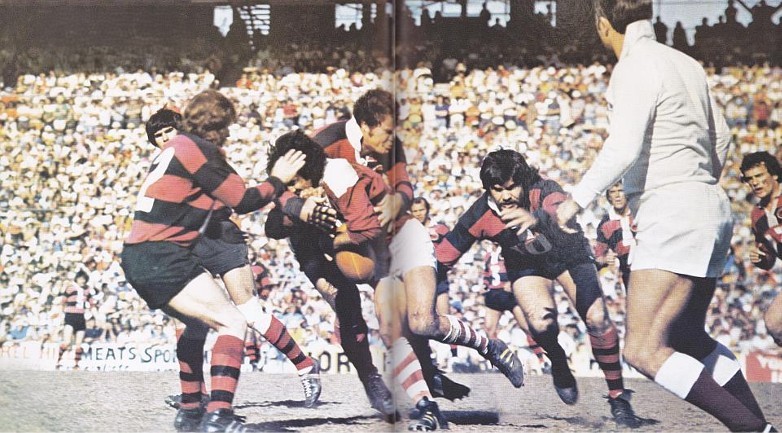
And Gutugutuwai and Batibasaga are, of course, immortalised in the famous image from the ‘boots-n-all’ brawl in the round 12 game between Souths and Wests at Lang Park.
To be fair, it was by all accounts a spiteful game from the get-go, though the two Fijians setting upon Wests lock Terry Haggett was the the moment when the niggling, cheap shots and simmering tension escalated into what seems to have become a vicious rolling brawl. Wests emerged from the bloody carnage to win the game 33-10.
It wasn’t just the Fijians, it wasn’t just Wests and Souths, and it wasn’t just in Brisbane. Such violence was to become synonymous with rugby league in the 1970s and 80s.
But even amid some pretty scary stuff , there were lighter moments. The game between Valleys and Easts in round 20 was another spiteful affair, during which Arthur Miers of Valleys and Kev Stephens of Easts engaged in the season’s longest punch-up. Apparently none of their teammates were interested in joining this particular dispute and the Sunday Mail reported that “while they staged their semi-wrestle with a few well spaced uppercuts (one every 10 seconds) the other players of both sides managed to get through a set and a half… for Valleys to score”.
Prop forwards, eh. You have to take the good with the bad and the mad.
Who was the first to go ‘around-the-corner’?
It is commonly held that John Gray, the former England international who played for Manly and Norths in the Sydney competition between 1975 and 1983, was the pioneer of around-the-corner goal-kicking in Australia.
There are some others who claim it was actually John Archibald of Parramatta, though it should be noted that Archibald played just the one first-grade game in Sydney, in 1972, and didn’t land a goal in that game.
All I know for certain is that Mr Archibald, as I knew him (he was my high school maths teacher), certainly lays claim to being the true pioneer. And it is entirely possible that he was kicking ’em around the corner, albeit in the lower grades, before Gray came along in 1975.
But could the true pioneer actually be the Wolf of Wynnum, Bob Patterson? It seems possible.

Results from every game, point-scorers and other bits and pieces are available from the 1970 season page. More complete BRL seasons are coming soon on Redcap’s BRL.



Leave a Reply