Before and after the flood: The 1974 season and the future of the Brisbane Rugby League

Before the flood
Foundation. Tradition. Since 1908…
Turn on an NRL game at the weekend and you’re bound to hear some combination of these words, possibly in the guttural and cringe-inducing tones of a Matt Nable monologue.
Nable’s remarkable ability to prompt any right-thinking person to immediately reach for the mute button aside, most if not all of what he refers to is the history of the NSWRL/ARL/NRL, including the likes of the Brisbane Broncos who in 1988 joined what was then essentially the Sydney competition.
And that’s fine. There’s a lot to be proud of there. A shiny event/television spectacular and big business watched by millions of people, including possibly a handful of bemused Americans in Las Vegas. A small group of its clubs can trace their roots all the way back to a couple of guys – JJ Giltinan and Henry Hoyle – perambulating the streets of inner-Sydney in 1907 trying to sell their vision of something a bit more communal and collectivist to disaffected rugby union players.
The subversive script arrived in Brisbane a short time later, with the likes of Jack Fihelly (brother of Mick Fihelly, the original Redcap) doing the leg work, and the city developed its own club scene, though to put it mildly, it trod a slightly more chaotic path in its early days. But it was, for the best part of 80 years, one of Australia’s two top-tier rugby league competitions, and it should be recognised as such.
We should be aiming for a world in which a commentator, when considering the historical significance of modern-day rugby league achievements, might also look back at the history of the Brisbane Rugby League for precedent. But that rarely happens, and it’s hard to blame them given that there is still a big, Brisbane-shaped hole in Australian rugby league’s historical record, at least some of which is due to the events of 1974.

As I write this, it’s just a few days since Alex Johnston broke Ken Irvine’s all-time record of 212 tries in the NSWRL/ARL/NRL. I mention this not because anybody in the BRL scored that many (though Fonda Metassa would slot into the top 10 if his full record was considered) but because recent discussions have mentioned Harold Horder, the man who held the record before Irvine.
Horder’s record on Rugby League Project has recently been updated, with stats from his stint at Coorparoo in the BRL now included, alongside his work with South Sydney and North Sydney. There’s a long way to go and a few obstacles still in the way, but we are getting there.
While this is most welcome, and while this website has played a small part in bringing such things about, I do keep coming back to some troublesome questions: what exactly do we mean when we talk about the Brisbane Rugby League? And how do we compare it to the NSWRL?
Unlike in Sydney where the club competition largely resisted any major structural reforms until the 1980s, the BRL is full of inflection points.
From the meeting at Café Majestic in early 1914 which formalised ‘electoral district football’, only for the concept to be quickly rendered moot by World War I. To the events of 1922, the ‘official’ formation of the BRL, when the clubs who’d emerged from the roiling primordial stew of the proto-BRL looked around and said, ‘hey, this is our league’ and proceeded to wrest control of their affairs from the QRL.
There was the BRL-QRL civil war later in the ’20s, the breakaway QRL competition and the hastily arranged reunification cup competition of 1930. Then there was the establishment of the district clubs in 1933, a time the likes of Easts, Norths and Souths, all of whom have roots going back much earlier, more or less consider their foundation point.
While I’ve never been one to base my understanding of history just on dates and official titles, these were important events which, in one way or another, shaped how the game was talked about, how it was covered by contemporary journals, and what detailed records remain.
Which brings us to the other event which has, very much for the worse, shaped present-day understanding and appreciation of the BRL: the great Brisbane flood of 1974.

It’s probably fair to say that everybody then in Brisbane was touched by it in some way. 16 people lost their lives. Something like 8500 homes in Brisbane and Ipswich were totally or partially flooded. The damage bill reportedly exceeded $10 billion in today’s money.
Bemoaning the loss of rugby league records in the context of such a disaster would be crass, though the flooding of the QRL offices at Milton and the destruction of paper-based records is generally considered to be one of the main reasons why the BRL’s historical record is so lacking.
Then again, it’s not entirely clear what was destroyed. There were suggestions at the time that staff had removed some records before the flood waters got in, only for those records to never be returned. And I’m surely not the only one to have noted that record-keeping after January 1974 left much to be desired. If the BRL was recording its own history throughout the rest of the 1970s and ’80s, or if they’d commissioned somebody to do it for them, where is it?
It has largely been left to the clubs to answer questions like: how many BRL games did Wally Lewis play? Those who wished to understand more than what can be gleaned from a league table, a few folksy recollections of finals games and some grainy Youtube clips have been left to piece it together from diffuse secondary source material.
And I’m not talking about myself here. I’m actually a bit of a Johnny-come-lately who happened to notice that the work done by some of the clubs on their own histories and the research undertaken by people like Roger Waite, along with the National Library’s phenomenally useful Trove archive, provided a foundation for somebody with an obsessive personality and too much time on his hands to maybe piece it back together.

So, where to from here? Well, the record has been pieced together and will eventually be published in full. We will have a deeper record of what each of the clubs did – not just their wins and losses but the sequence of their results, their head-to-head against other clubs and whatever else can be gleaned from that.
It’s when we get to the players – the guys who actually created the history we’re concerned with and the main reason why you’d bother with an exercise like this – that the obstacles and definitional questions arise.
It will be very difficult to compare the records of players in Brisbane and Sydney during the period from 1912 to 1919 simply because we don’t have many team lists from this period. What started as indifference or hostility among the local papers in 1912 continued due to the Great War and then the Spanish Flu pandemic in 1919. The prospect of finding the missing details now, after more than a century, is probably somewhere between slim and none.
The level of detail improved in 1920 and ’21, but we don’t have a complete dataset until 1922. There were some issues during World War II, though probably not enough to render comparisons inapt. The period from 1948 to ’68 is patchy, in large part due to newspapers favouring prestige-based commentary over detailed, substantive reporting, but I think the missing details from this period can be found. I’ll need a little help, though.
There’s plenty which can be referred to from the period between 1909 and 1921 (the proto-BRL) – Wests’ undefeated premiership in 1920, Valleys’ three-peat, the great Ipswich team of 1910 – but if a reasonably complete and comparable dataset, something without too many asterisks and which feeds the BRL into the sort of analysis it should be part of is the goal, treating 1922 as day dot might be a good idea.
It’s not ideal, but it makes sense in terms of governance arrangements and official titles. It would also avoid the early chaos and churn, all the electoral district teams who came and went, and the frankly bizarre 1920 season – one of Harry Sunderland’s specials.
Carlton, the direct ancestor of Souths, were well established with West End gone for good. Coorparoo (Easts), too. Brothers were in for good and Grammars (Norths) came back in 1924. Wynnum version 1 would not be included, but they were one of the electoral district teams of 1914, and Wynnum version 2 (1931-32) are much more closely related to today’s Seagulls.
It’s a mostly straight line from ’22, through 1933 to the bitter end. The parallel QRL competition in 1929-30 can be treated much like the 1997 Super League (a silly, contrived distraction which doesn’t count). The 1930 League Cup like the NSWRL City Cup.
As always, I’d love to hear your thoughts.
After the flood
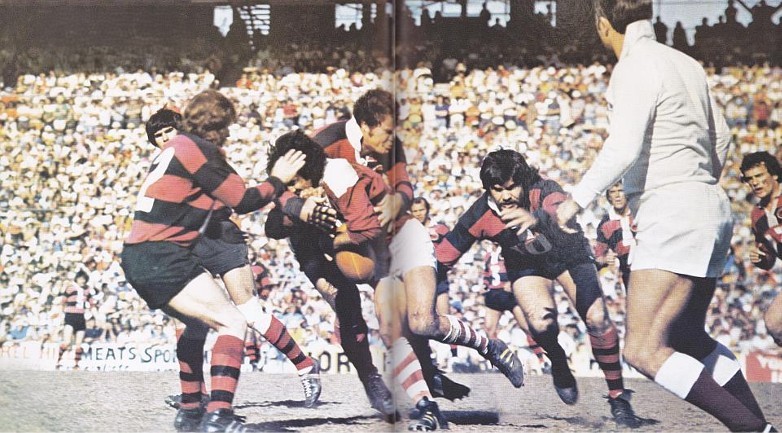
While the city was a bit soggy throughout much of ’74 – just ask the visiting Chelsea team – the BRL went on.
Valleys won their fourth title in five seasons after victory over Brothers in a try-less Grand Final.
There was something of an English invasion – Tommy Bishop and Geoff Wraith at Norths, John Kirkbride and Steve Lyons at Souths, and John Ward at Easts.
But the pick of the imports were Brothers’ duo Tony White (St George) and Ian Sartori (Newtown) from Sydney. Along with Wayne Bennett, Ian Dauth and veteran hooker Brian Fitzsimmons, the Brethren surged past a handy Norths outfit and a talented but inconsistent Souths to make their first Grand Final since 1968.
The story of the season was arguably the wooden-spooners, Wests. A team which boasted Kangaroos Ian Robson and Warren Orr, dual international Geoff Richardson, the prolific Wayne Stewart, an excellent half in Greg Oliphant, young gun John Ribot and captain-coach John Sattler somehow managed to finish a distant last, winning just five games all season.
That was it for Sattler at Wests, with the champion former Rabbitoh moving to Norths for one last season in 1975. Ron Raper, after finishing his playing career at Redcliffe, moved to Wests as coach and things went rather better for the Panthers in 1975.
Details from every game are available from the 1974 season page. More complete seasons are coming soon on Redcap’s BRL.



Leave a Reply