Raging against the dying light

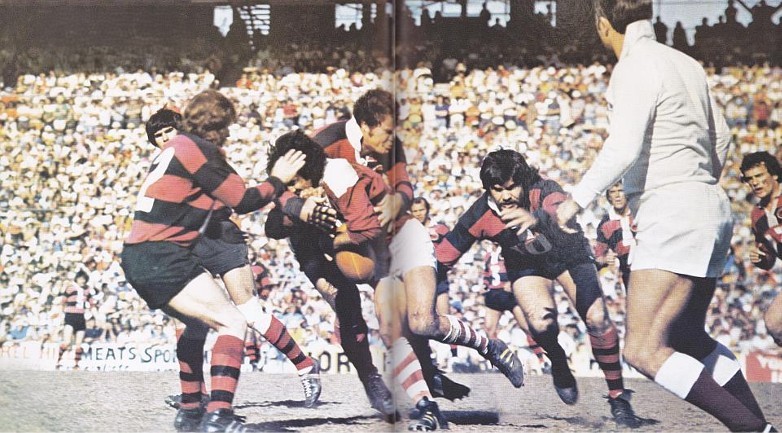
When reviewing the 1958 season, I remarked upon Barry Muir’s debut in the BRL, describing him as a pugnacious halfback from the Tweed who was destined for great things, and who would ultimately be banished from the BRL after a series of rash decisions in 1968. Well, it’s time to talk about those decisions, and about Barry Muir, a complicated and divisive, yet fascinating figure in rugby league history.
There were some other things going on in ’68, though, so I’ll cover them before we get back to the infamous ‘Garbo’.
Brothers, the defending premiers, looked the best team in the early going, then gradually confirmed that impression. International Dennis Manteit led a formidable and dynamic forward pack, with lock Wayne Abdy continuing to do a strong impression of Babe Collins on the attacking front. Neville Harman was a prolific goal-kicker. Eric Gelling and Barry Dowling called the shots. John Gleeson even came out of retirement to give the Bretheren enviable depth.
Norths and Valleys were, as usual, thereabouts. Norths were retooling, with many of the team who’d brought them seven premierships in eight seasons either gone or slipping into semi-retirement in the lower grades.
But Jim Hannam, former premiership-winning half and by now reserve grade coach, ended up the starting fullback after an injury to Max Henderson, and the Devils still relied heavily on a cadre of veteran forwards a little way past their prime.
It was a similar story at Valleys. Henry Holloway, mastermind of Redcliffe’s triumph in ’65, was evidently trying to implement a more thrusting attacking style but didn’t really have the troops to do it, or at least do it well. Ross Threlfo and Marty Scanlan were a quality halves combination, but the rest of the platoon were a bit workmanlike, and they still relied heavily on the boot of portly prop Des Mannion to keep them in the battle.
Despite the blow of Ken Haimes’ departure for Newtown, Easts were the season’s biggest movers, qualifying for their first Grand Final in fifteen years after defeating Valleys in the Preliminary Final.
The Tigers got the better of a curious swap which sent fullback Max Henderson to Norths and brought back Peter Lobegeiger, a similar but far more consistent player and a key part of Norths’ 1966 premiership team. Hooker Reg Webster and hulking prop Danny Ryan were joined by a bunch of young back rowers, including one Des Morris who would go on to lead the Tigers through a golden era in the 1970s.
But perhaps the biggest difference was the appointment of Les Geeves as captain-coach, with the champion former Norths forward bringing his own brand of quiet but effective leadership, and a welcome change after a tumultuous few years under Clive Churchill and Syd Clarke.
While Easts were no match for Brothers in the Major Semi-Final or Grand Final, for the first time in a while, the future looked bright for the Tigers.
By contrast, the future looked very uncertain across town at Wests. It had been another disappointing season on the field and the increasingly erratic and self-centred behaviour of captain-coach Barry Muir hadn’t helped.
Steve Haddan described the events surrounding Muir in ’68 as ‘the Barry Muir meltdown’. Max and Reet Howell called it “a sad twist in the twilight of an illustrious playing career”. Steve Ricketts was blunter, noting that “he was banned from Brisbane football for allegedly spitting at referee Dale Coogan” (the word ‘allegedly’ here relates specifically to the word ‘at’, not the word ‘spitting’).
While he continued playing up north and on the Tweed Coast for a few more years afterward, Muir’s top-grade career ended in August 1968 when the Brisbane Judiciary Committee handed down a 12-month ban, just a few days after he was sent off in Wests’ defeat to Easts in round 21.
Being exiled in disgrace was indeed a sad end for one of the finest players of his generation – a 26-Test Kangaroo, NRL Hall of Famer, BRL Team of the Century halfback and one of the 100 Greatest Players of the century – but it’s hard to look at Muir and his record without thinking that there was always a fair chance it was going to end badly.
Despite hailing from northern New South Wales, Muir became an icon to many Queensland rugby league supporters; an outsider who reflected a subculture back at itself. He embodied the strain of state parochialism which tends to define itself primarily by what it isn’t and manifests in distrust of and antipathy toward those from south of the border. Muir’s enduring contribution to this was labelling the NSW rugby league team ‘cockroaches’.
Muir also took enthusiastically to another tradition in these parts – distrust of and hostility toward referees. I’m not sure what it’s all about – some kind of issue with authority figures; perhaps an instinctive suspicion of anybody who claims impartiality, as if the mere notion is an agenda in itself, probably part of a plot emanating from south of the border.
Queensland’s never had much of a tradition of anti-authoritarianism at a political level – quite the opposite. To borrow and adapt a line originally written about the strange interplay of politics and sport in Spain, ‘any people who allow themselves to be ruled by a dullard like Joh Bjelke-Petersen for 20 years but can’t accept the decision of a referee clearly have a complicated relationship with authority’.
Whatever the case, Muir’s actions in 1968 fit snugly alongside the riots at the 1909 Premiership Final and 1949 Grand Final, the cowardly actions of players like Arthur Henderson and George Sokell, beer cans raining down on Lang Park, Gorden Tallis and Bill Harrigan, the enduring love affair with Barry Gomersall, or more accurately, Barry Gomersall’s candour.
For Muir, referees were, or at least came to be, the enemy. And it was personal. A few years later, he told author Alan Whiticker that “it was well known in Brisbane that referees had to get over the top of [me], if they wanted a career in football”.
Unfortunately, I didn’t keep track of how many times Muir was sent off during his club career. Suffice to say it wasn’t a rare occurrence. And if you believe that your actions are not the problem; that an agenda among the refereeing fraternity is the problem; that compromise isn’t an option; that you are, in fact, the victim, things can really only get worse from there.

Which is not to say Muir wasn’t unfortunate in some respects. There was some bad luck along the way. Mostly, though, it was just bad timing.
He emerged with a bang, energising a Wests team on the slide after its 1954 premiership and leading them to the top of the table in 1958. But Wests departed that year’s finals in straight sets and over the following ten seasons he would play just two more finals games, losing both. He never really came close to a BRL premiership.
Brothers took the premiership in ’58, then Clive Churchill turned up at Norths the following year and kick-started what would, with the expertise of Bob Bax and a generational group of players, become a decade-long hegemony which left most other clubs watching on in awe.
Wests and Muir could do little else but watch. They failed to make the finals in the last six seasons of his career. The Muir-Ken Day-Col Weir teams flashed their ability on occasion but did little else with it. Gary Manson never quite panned out. Johnny Rhodes provided new hope in ’67 but was immediately poached by Canterbury.
After some early success in the 1959 and ’60 interstate series, the reality of the financial disparity between Sydney and Brisbane kicked in at that level too. Muir’s Queensland teams failed to win any of his last 12 games at state level. He did alright at international level and was perhaps unfortunate to be discarded after the 1963 Kangaroo Tour, though it should be noted that his successor was the great Billy Smith, another worthy Hall of Famer.
Queensland selectors moved on the following year, with Eric Gelling, Abe Weimers and Col Reynolds favoured over Muir after ’64, though there were still some cheerleaders in the press demanding that they ‘bring back Barry’. He did come back for a dead rubber at Lang Park in 1966, but that was it.
So, by the time 1968 rolled around, Muir was captain-coach of a Wests team who hadn’t made the finals in five years and weren’t looking likely to improve. It seems he still harboured an ambition to play representative football but was blocked at every level. He had a well-earned reputation for on-field misdemeanours and a simmering resentment toward referees. What could possibly go wrong?

The first flashpoint arrived in Wests’ round six game against Valleys at Lang Park. In the second half, with Valleys having just taken a lead of 19-8, Muir confronted referee Rick Pollock regarding a scrum in the lead up to Valleys’ try and was sent off. According to Pollock, Muir threatened to take the Wests team from the field if he was dismissed. Pollock sent him off anyway and Muir followed through.
Wests’ President and legendary former player Tom Purtell was not impressed and told Muir to send the players back onto the field. Muir ignored him, led his players into the dressing room and forfeited the match. Purtell later issued a public apology and ordered Muir to personally cover half of the $300 fine issued to the club. He was also suspended from playing for a month
Muir affected contrition in public, telling the Courier Mail upon his return that “I have had time to think… I must keep my mouth shut”. Ultimately, he couldn’t even accept his own advice.
Two months later, Wests finished their season with a game against Easts at Lang Park. With Wests well on their way to a 30-9 defeat, Muir became engaged in a running verbal battle with referee Dale Coogan. According to Muir, “I was terribly worked up over the string of penalties against myself and Arty Connell and I just blew my top”.
Coogan ordered Muir from the field. Muir turned to leave, then turned back as if to continue berating the official. Coogan wiped his face. Muir finally left.
According to the Sunday Mail’s Jack Reardon, Muir immediately admitted to having spat on Coogan’s face, though he later claimed he hadn’t intended to do this (quite what he was intending to do was unspecified).
After the BRL handed down a 12-month ban for the spitting incident, abusive language and refusing to leave the field – a ban considered manifestly inadequate by the Referees Association – Muir indicated his intention to appeal on the grounds of provocation, stating that “I felt I was being victimised… this bloke has been getting at me with penalties all the time”.
The appeal never went anywhere and that was it for Garbo. He returned to Brisbane to coach Redcliffe in 1973, had a stint as head coach of Queensland from 1974-78 and spent some time as a rather colourful television pundit.
Despite his many flaws – or possibly even because of them – he remained a much-loved figure in Queensland. According to Steve Ricketts’ obituary in 2022, “In retirement, Muir was regularly visited at his Tweed Heads home by the men he coached and played alongside, as they had a special affection for one of the great men of Queensland football.”
The Barry Muir I’ve come across in researching the history of the BRL was a great player. He was also paranoid, volatile, sometimes violent and, above all in the final throes of his career, selfish. His actions in 1968 were those of a desperate man who didn’t see much of a future in the game. Rather than taking the role of captain-coach seriously, being a leader and trying to leave a positive legacy at Wests, he went down in an outburst of spittle-flecked fury and self pity.
Then again, I wasn’t around in the 1960s or ’70s, so it’s hard for me to understand the more visceral appeal of Barry Muir; to appreciate how his rage at the dying light, at his own perceived marginalisation, might’ve reflected a broader resentment; how his unfiltered parochialism in the 1970s really connected with a generation of rugby league folk.
Wests could surely have done without his acrimonious departure and the venerable Tom Purtell certainly deserved better. But it may have been for the best, letting new leaders emerge from the shadow of Muir and his ego.
Wests had a bounce-back year in 1969, making the finals for the first time in seven years behind young back-rower Ian Robson and new captain Gary Manson. Wayne Stewart and Richie Twist debuted. Greg Oliphant joined in ’71 and took over the reins as halfback. Their own home ground and clubhouse at Purtell Park opened in ’73…
Actually, the future didn’t look too bad at all.
The complete record of the 1968 season is available from the 1968 season page. More complete BRL seasons are coming soon on Redcap’s BRL.



Leave a Reply