
The divergent evolution of rugby league from rugby union has been a gradual process over the course of more than 130 years now; incremental shifts in practice and interpretation, deployment and positioning.
There have arguably also been four epochal shifts; one of which started the process and three of which accelerated it.
The first was, of course, the Northern Union breakaway in the 1890s, which was more about principle – fairness, a duty of care, compensation for players – than on-field practice. There were two fewer players on the field and at least some effort to produce a spectacle for the public but in many respects rugby league still looked a lot like rugby union – lots of kicking and for quite a while plenty of bodies in and around the ruck.
The third was the extension of space between the ruck and the defensive line, from five metres to ten metres in the early 1990s. The change was intended to create more space for attacking play and make life more difficult and tiring for defenders. It was so successful that it ended up tearing the game in Australia apart through Rupert Murdoch’s partly successful attempt to stage a hostile takeover in the mid-1990s.

The fourth – and here some may disagree – were the rule changes implemented during the COVID-19 pandemic by ARLC Chair Peter V’Landys, bringing about the ‘Vlandys-ball’ era as some have put it.
Vlandys-ball was based on a similar premise to the changes of the early 1990s – making life more difficult and tiring for defenders, this time through reducing stoppages. But it’s had a broader effect in terms of possession flow, with the near-constant elongation of attacking sets through a combination of the existing seven-tackle rule (which is thankfully being modified slightly) plus frequent resets to the tackle count during play. This isn’t just a further shift away from the spot-vertical shift-contest model of rugby union, it has some faint similarities to the way possession is regulated in American ‘football’.
This, plus the reintroduction of two-point field goals in certain circumstances, is an interesting evolution when looking back on the second big epochal shift: the move from unlimited tackles to limited tackles for attacking sets in 1967.
Of the four big epochal shifts, the reforms of ’67 were by far the most significant, mostly because they were premised on preventing certain practices; in other words, a direct intervention to change how the game was played.
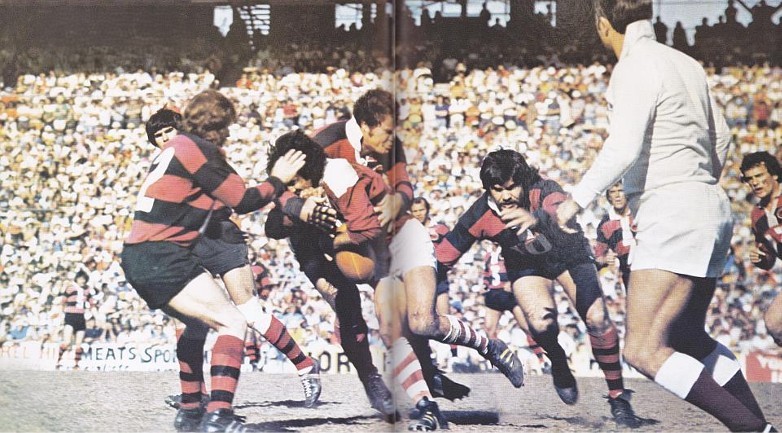
The great St George team in Sydney (11 straight premierships) and the great Norths team in Brisbane (six premierships in eight years) had both achieved tremendous success through an attritional style of play based on long periods of possession, with reports in Australia and England of some teams gaining a near monopoly of the ball. It was highly effective, but far from pretty.
From 1967 teams would be limited to four tackles in possession (this was extended to six tackles in 1972). ‘Use it or lose it’ was the message.
As it happened, most teams chose to use it by way of the field goal. There were a total of just two field goals kicked during the entire 1966 BRL season, and one of those was John Brown’s two-pointer to clinch the Grand Final for Norths. There were a total of 68 kicked during the 1967 season – a 3300% increase – along with countless unsuccessful attempts.
Valleys’ Des Mannion was the field goal king of Brisbane, booting a total of 15 across the season. The Diehards were still struggling to score tries and Mannion’s obsession with field goals was surely part of the reason why.
Brothers’ one-point loss to Norths in the President’s Cup Final was in part due to two field goals by Peter Lobegeiger. But as the Sunday Mail pointed out at the time, Brothers’ fullback Frank Drake had failed with six field goal attempts during the game. Maybe a bit of variation in the attack might have been a good idea.
The obsession with field goals would last a few more seasons before the game’s governing bodies reduced their value by half in 1971, and with it, some semblance of urgent, constructive attacking football was finally restored.

Despite Frank Drake’s dodgy field-goal kicking, 1967 saw the Fighting Irish of Brothers (Past Christian Brothers to give them their full name and explain the Irish bit) break through for their first premiership since 1958 and lay to rest the ghosts of their defeats to Norths in 1964 and ’66.
The Grand Final was a tight and “furious defensive struggle” eventually won 6-2 by the Irish, though shockingly no field goals were involved, with Brothers’ back-rower Noel Cavanagh booting three penalty goals to Norths’ one to clinch the victory.
After winning all six Grand Finals they’d contested since ’59, Norths were finally bested on the big day. They’d had their issues throughout the season – more concerns about fitness among key players like Henry Hegarty and Fonda Metassa, a revolving door at halfback – but they were still there and oh so close again. The Norths hegemony wasn’t quite over yet.
Elsewhere, Easts finally got back to the finals but there were once again dramas off the field, with the suggestion of a major rift between the selectors and coach Syd Clarke over the selection of reserve grade prop Charlie Porter as a winger in first grade. Like Clive Churchill before him, Clarke was quickly dispensed with. Better days were ahead for the dysfunctional Tigers.
After a few years wandering in the wilderness, Wynnum, by now officially known as the ‘Seagulls’, returned to the club’s spiritual home at Wondall Road (now Kougari Oval).
Redcliffe continued their decline after the high of ’65, and their fortunes were not helped by what turned out to be a career-ending injury to champion lock Colin Weier who sustained burns to 25% of his body after his shirt caught fire at a family barbecue. It was a sad end to a great career by one of the club’s foundation players.
All clubs were now living with the constant threat of poaching raids from their cashed-up counterparts in Sydney, despite the QRL’s attempts to ban the transfer of its best players. Multiple Sydney clubs were after Wests’ exciting winger Johnny Rhodes, Newtown were after Easts halfback Ken Haimes and North Sydney were chasing Brothers captain Peter Gallagher and goal-kicker Cavanagh. The Bears even reportedly sent Gallagher a blank cheque, so desperate were they to lure the great prop.
Gallagher and Kavanagh challenged the application of the QRL’s ban in court, though both were forced to remain in Brisbane for the ’67 season. Ultimately, there was little the clubs or the QRL could do. Cavanagh, Haimes and Rhodes all went to Sydney in 1968, while Gallagher opted to retire and move into the media industry, where he remained a prominent commentator for many years.
Despite the blow, Brothers would fight back and challenge again in 1968. Their premiership in ’67 was more than the luck of the Irish. They won the Grand Final without centre Des Smith, champion lock Wayne Abdy, half John Smith , young back-rower Glen Brown and veteran fullback Drake.
Former Devil Barry Kenning, former Panther Reg Cannon, former Magpie Adrian Baggio and the injury-prone Eric Gelling all stepped up when needed, and most would do so again in ’68.
Details of every match are available from the 1967 season page. More complete BRL seasons are coming soon on Redcap’s BRL.



Leave a Reply